
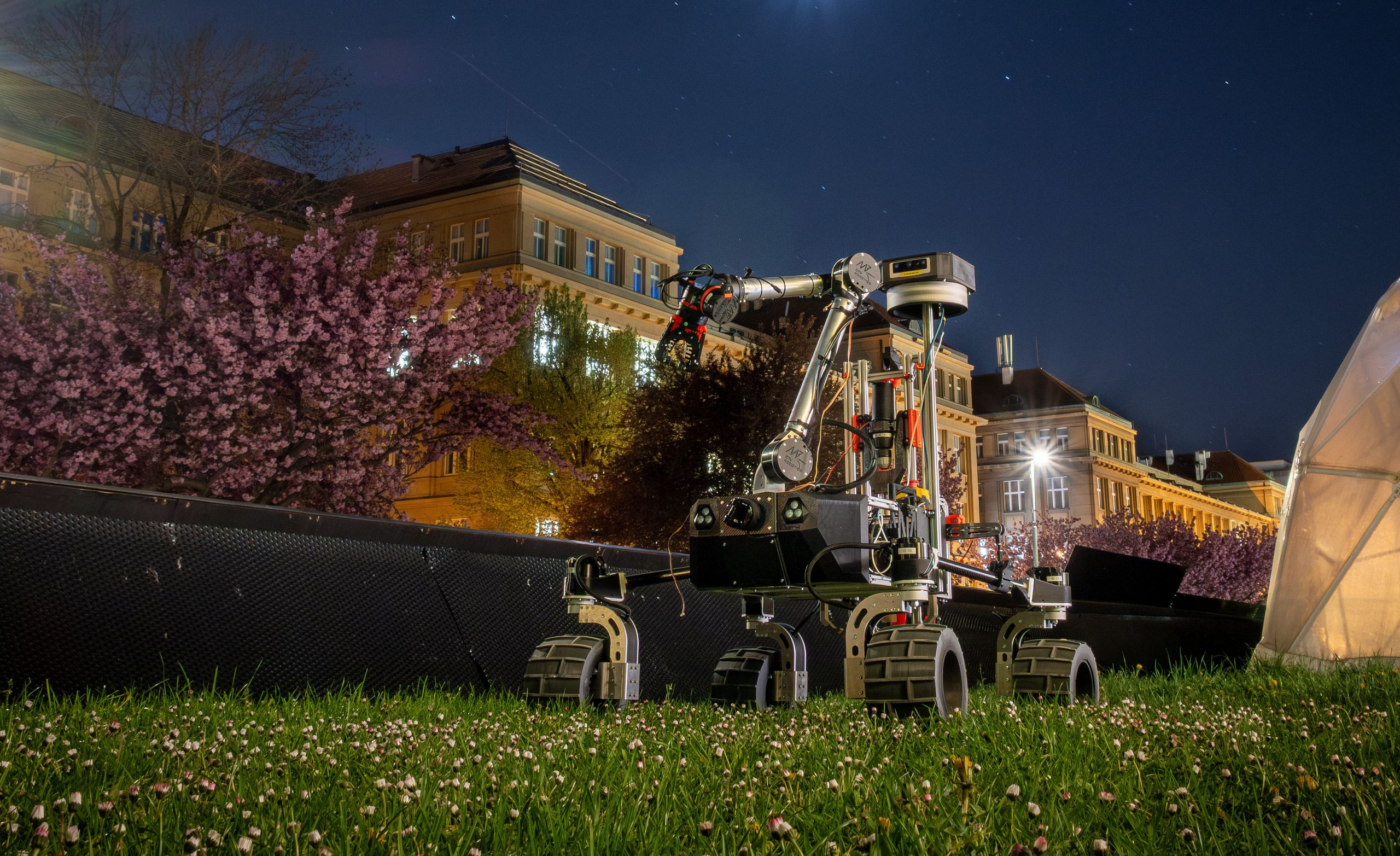
Get to know our newest rover
PERUN Gen 3
Overview
Project PERUN GEN 3 is our best student rover yet. This mobile robotic platform is not scared of rough environments or complex tasks. It has an arsenal of tools and sensors to help it take on any challenge. Designed and built entirely by the CTU Robotics team. Oh, and PERUN stands for Planetary Exploration Rover with Unmanned Navigation.
- Weight (with modules)
- 58.3 kg
- Wheels Driven
- 4
- Number of Axes
- 6
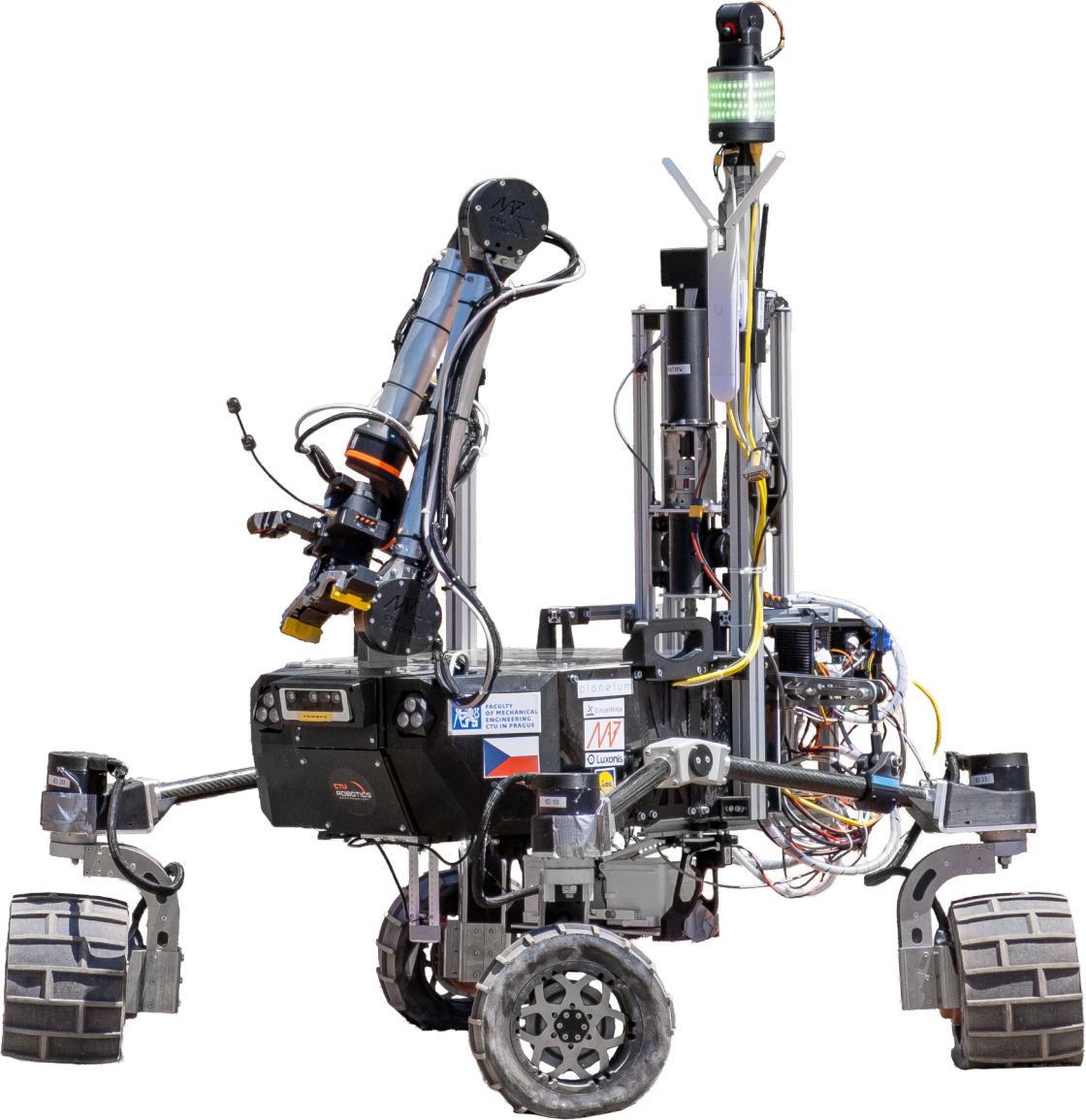
Explore the rover
Dimensions
- Length
- 108 cm
- Width
- 101 cm
- Height
- 140 cm

01
Chassis
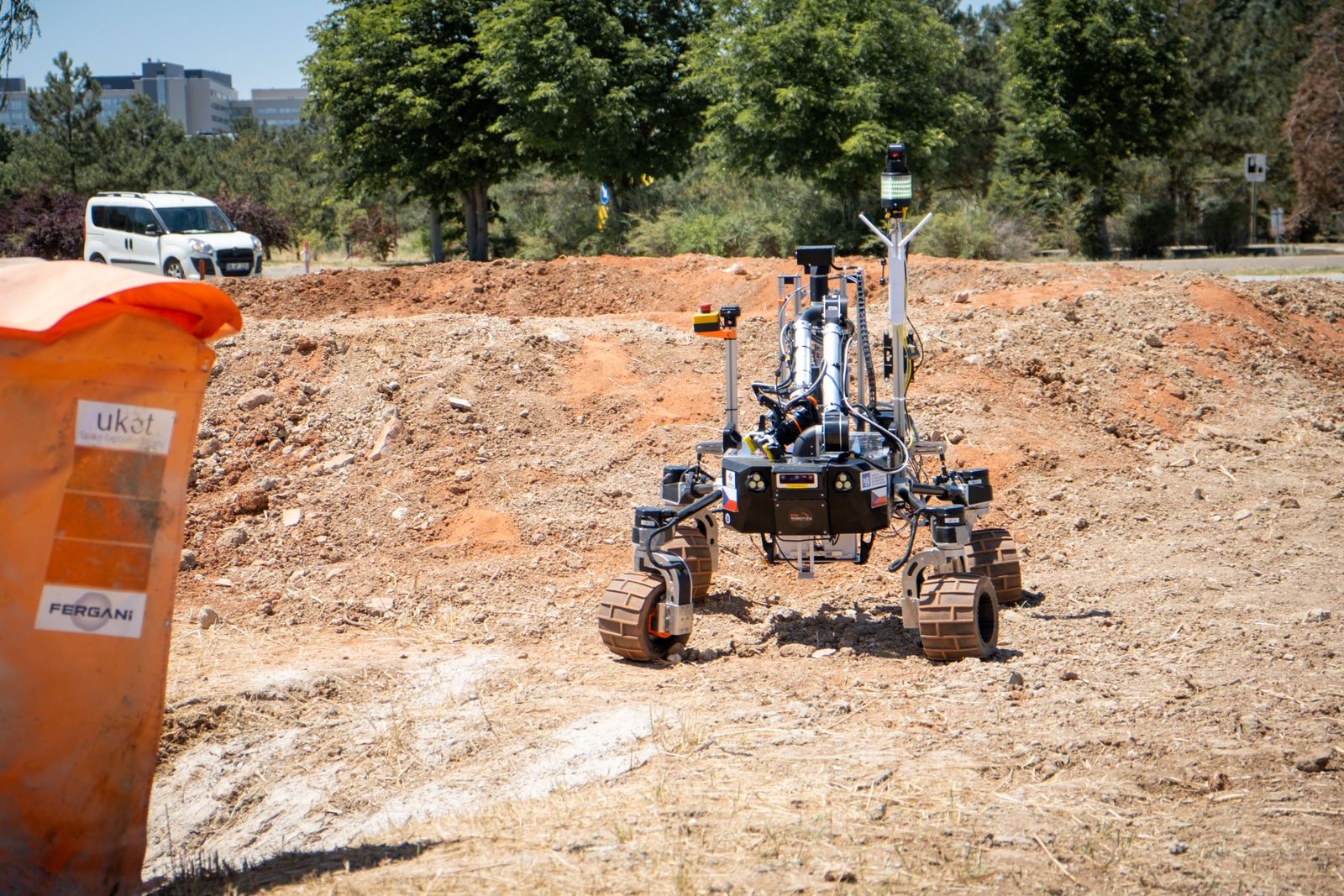
The mobility system is based on rocker kinematics with an 850 mm wheelbase and a low centre of gravity under the main frame, so the rover stays stable in rough terrain, climbs slopes of more than 40° and gets over obstacles with ease. The whole chassis is modular, so repairs are simple and fast. Carbon fibre, aluminium and 3D-printed PETG and PC-carbon parts make it more than 25 kg lighter than Gen 2. The electronics sit in a sealed aluminium frame with mounting points for the robotic arm, the drilling tool and the camera tower, and a wheel design with integrated grounding protects them from static electricity.
- Wheels Driven
- 4
- Empty chassis
- 44 kg
- Wheelbase
- 850 mm
- Climbs slopes
- > 40°
- Lighter than Gen 2
- > 25 kg
Built by Mechanical Department
Back to the rover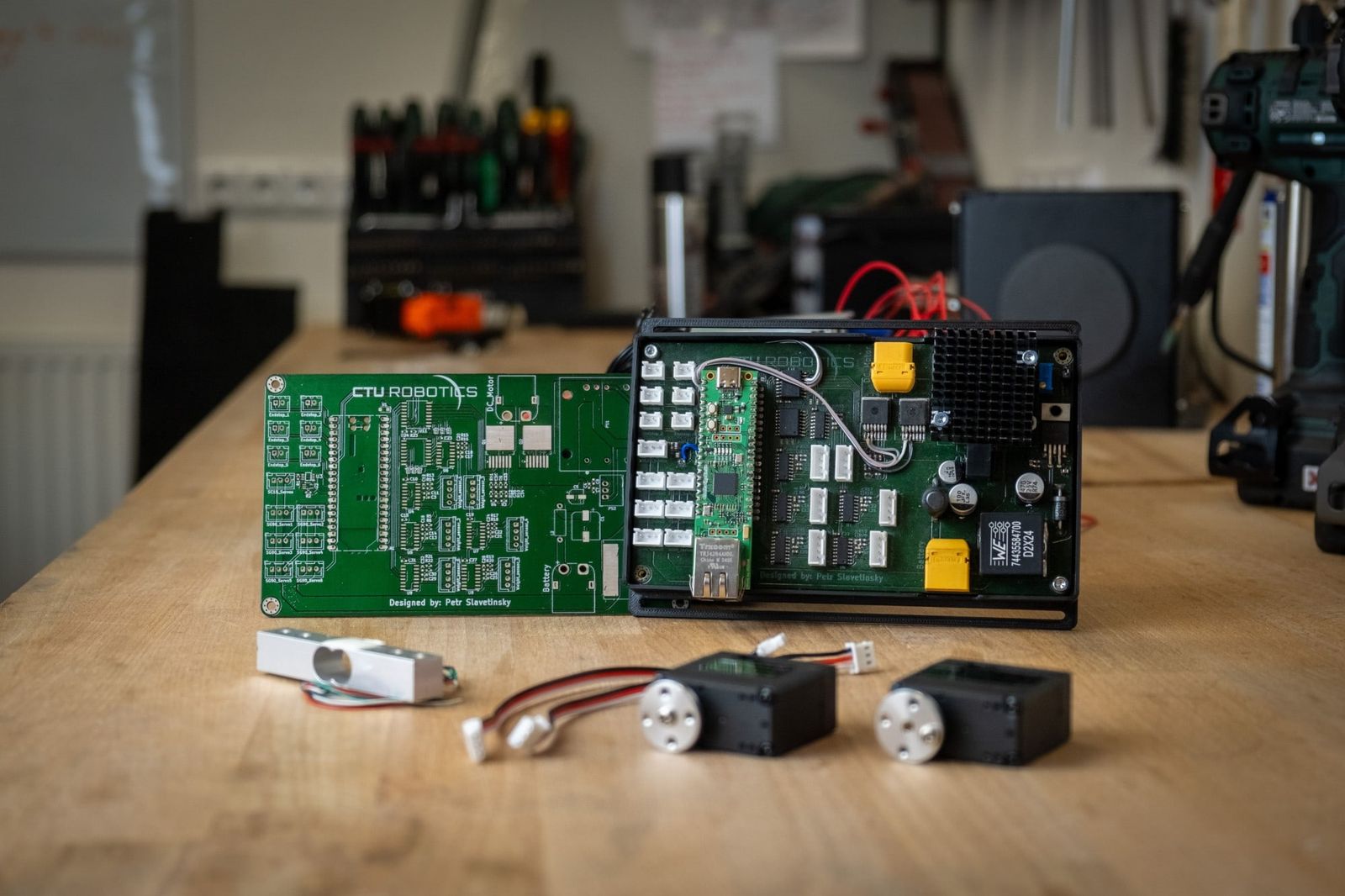
02
Electronics & Embedded
At the heart of the power system is a custom-assembled pack of high-density lithium-ion cells: 12 Ah at around 40 V nominal, about 500 Wh of energy. A commercial BMS handles cell balancing and thermal and overcurrent protection. Our own PSU board distributes the power, with step-down converters, switchable outputs and current monitoring on every branch, and an emergency stop that instantly cuts power to all motors. BLDC motors with integrated drivers and planetary gearboxes talk over a CAN bus. An Intel onboard computer with 32 GB of RAM runs mapping, sensor fusion and mission logic, while two Raspberry Pi boards control the base and the arm. Wi-Fi is the main link, with LoRa as a backup for critical telemetry and a low-latency FPV feed for manual driving.
- Battery (Li-ion)
- 40 V, 12 Ah (~500 Wh)
- Main computer
- Intel, 32 GB RAM
- Motor control
- 2 × Raspberry Pi
- Drive motors
- BLDC, CAN bus
- Perception
- LIDAR, RGB-D
- Communication
- Wi-Fi, LoRa, FPV
★ Best electronics award · ARC 2026
Read about ARC 2026
03
Robotic Arm
The manipulator is a robotic arm with six degrees of freedom, driven by MAB motors with rotary encoders in every joint. Its end effectors can be swapped, for example a gripper or a digger, and a camera on the gripper provides images and point clouds for autonomous behaviour and collision-free trajectory planning. The arm has its own Raspberry Pi, separate from the rover's computers, running ROS 2 and MoveIt 2 for trajectory planning and a server for manual operation.
- Number of Axes
- 6
- Reach
- 1040 mm
- Max Payload
- 5 kg
- Weight
- 11 kg
- Joint motors
- MAB + encoders
- Arm software
- ROS 2, MoveIt 2
Built by Mechanical Department
Back to the rover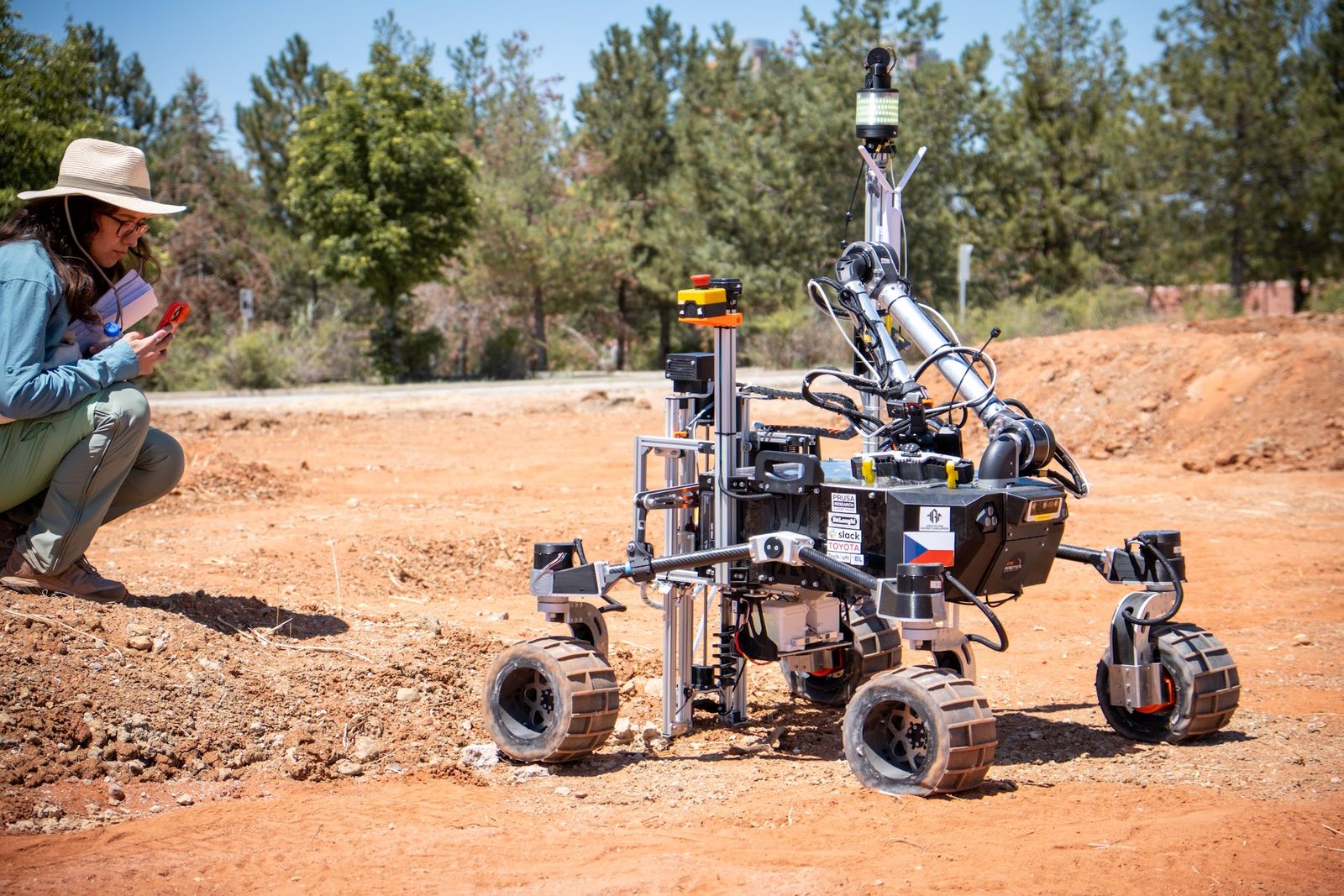
04
Drill tool
The drilling system is a two-level movable console: first the outer structure reaches the ground, then the drill bit engages. The system takes up to 300 g of soil from a depth of 30 cm, below the weathered surface layer. After drilling, the bit vibrates to deposit the sample into a sealed container that measures its weight and serves for onboard analysis of mass, texture and grain.
- Drilling depth
- 300 mm
- Max sample weight
- 300 g
Built by Mechanical Department
Back to the rover